Changelog
What's New
Every notable build since the in-game What's New panel came online in July, across Explore and Play.
feature new capabilityart visuals & assetsfix fixes & refactors
November 16
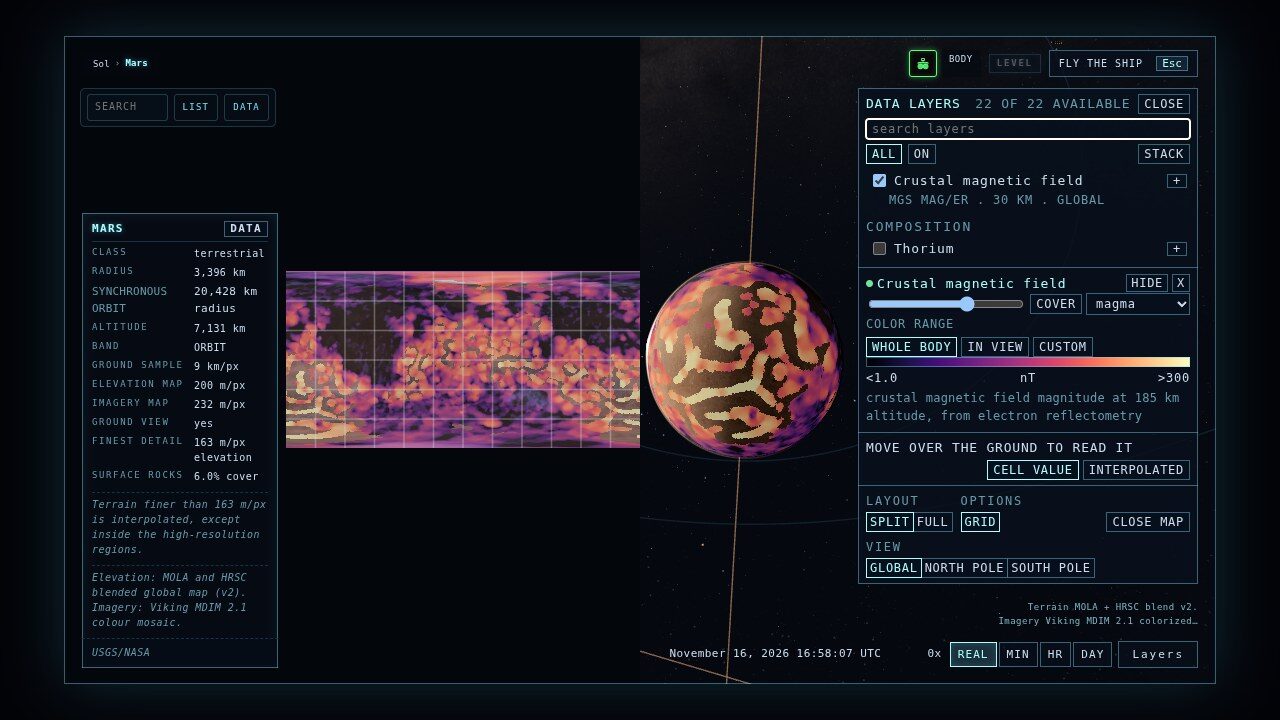
2026-11-16- featureData layers on nine worlds. Explore now draws 91 measured data layers over the Moon, Mars, Earth, Venus, Mercury, Ceres, Vesta, Pluto and Charon: gravity, crustal magnetism, surface chemistry, ice, temperature and more, each from a mission archive. Every layer opens on the globe and on a flat map beside it, with polar and near-side views, a value readout under the pointer and a card that cites its dataset, and every one is checked against its source at named points.
October 9
2026-10-09- fixEarth's surface stays steady at fast warp in Satellites view. Earth's surface no longer flickers or appears to turn the wrong way at fast time rates in the satellites view; it now blurs into zonal bands once the turn outpaces what a frame can show.
- fixGround brightness holds across the cut into a walkaround. The ground's brightness no longer jumps on the frame the camera cuts into a night walkaround at Jezero or Hadley.
October 8
2026-10-08- fixColony buildings now sit in their own ground shadow. Landing pads, tank farms and greenhouses drawn as models no longer stay lit inside a ridge's shadow; they now take the same terrain shadow as the ground around them.
- fixGO prices outer-system trips correctly. GO no longer underprices outer-system trips like Jupiter to Neptune; the departure burn is now priced by the same law the autopilot flies.
- fixMars arrival no longer stutters while the dust table builds. The frame hitch at the start of the Mars approach, while the dust table builds, is gone; the build now spreads its work across frames instead of blocking one.
- featureNine more HiRISE Mars sites are now explorable. Nine more HiRISE-survey Mars sites are now explorable, including Mawrth Vallis and Gale.
- fixRocket bodies and debris in Satellites stay current. Rocket bodies, debris and inactive payloads in the satellites view now update with each weekly snapshot instead of sitting frozen at an old date.
- featureSatellites get names, orbit lines and detail cards. Hovering or clicking a satellite in Explore now shows its name, draws its orbit for the current view date, and opens a card with its owner, altitude, speed, inclination and period.
- fixShadowed ground under air lights by the terrain's true horizon. Shadowed ground on worlds with air now lights by the terrain's own measured horizon, so open ground like Jezero's north scarp no longer reads too dark.
- featureThe ISS, Hubble and Starlinks draw as true-scale models up close. Get close enough to the ISS, Hubble or a Starlink in the satellites view and it now draws as a true-scale 3D model instead of a dot.
- featureThirty more real Moon sites are now explorable. Thirty more real lunar sites from LROC NAC imagery, including named domes, rilles, impact sites and basin rims, are now explorable in Atlas.
- fixWarp to next gets its own row in the bridge panel. WARP TO NEXT now takes its own full-width row in the bridge panel instead of being squeezed between CANCEL and AUTO-WARP, so its countdown no longer cuts off.
October 7
2026-10-07- fixHigh-warp trips no longer overrun the frame. GO trips past 50,000x warp no longer overrun the frame during flight integration.
- artJezero's ground reads its measured reflectance. Jezero's site ground is now drawn from its HiRISE label's measured reflectance instead of a contrast-stretched image, so its brightness is accurate.
- fixLeaving the Atlas no longer freezes the first frame. Leaving the Atlas no longer freezes the picture for up to 1.6 seconds on the first frame behind it.
- fixMars's sky and ground now light under the Sun's true color. Mars's sky, haze, ground and sunset glow are now lit by the Sun's own measured color instead of an approximate white or warm light.
- featureSatellites history goes back to 1957. A slider in the satellites view now plays back real catalog history from October 1957 to today, with 1 WK/S, 1 MO/S and 1 YR/S rates to run through it.
- fixThe climb past the colony overview's ceiling no longer jumps the view. Climbing out of a colony walkaround, the camera now eases smoothly past the overview's ceiling instead of snapping to the commanded altitude in one frame.
October 6
2026-10-06- fixA Layers list keeps its place when clicked. Clicking a row in a flight Layers list no longer jumps the list back to the top, and the mouse wheel over a panel now scrolls it instead of zooming the ship camera.
- fixAuto-warp no longer stops the clock at a course fix. On a GO trip that matches a destination's orbit, auto-warp no longer drops the clock to a stop and sits still while the course fix solves.
- fixEarth and the Moon match Horizons to 132 km. Earth and the Moon's position in the Atlas and cruise now reads within 132 km of NASA Horizons, down from up to 18,435 km off.
- fixEarth's orbit line no longer doubles through Earth. In the satellites view, Earth's orbit line no longer draws a second line crossing through Earth when the view jumps to a new date.
- fixMars's haze keeps Syrtis Major darker than Arabia. With the air on, Mars's disc from orbit now keeps Syrtis Major darker than Arabia, matching published albedo measurements instead of washing both toward the same brightness.
- fixNo brightness jump flying in to Earth or Venus. Flying in to Earth or Venus no longer changes the disc's look in one frame partway through the approach, the same fix already applied to Mars.
- fixThe build bar no longer covers plot controls. The plot controls sliders at a deployed rover site now stop above the build bar instead of sitting underneath it.
- fixThe delta-v map stays clear of other panels. The delta-v map no longer gets squeezed under CAPTAIN and SHIP SCHEMATIC, and COMMS keeps a fixed width when dragged out of its rail.
- fixThe night vision chip stays drawn when off. The night vision chip no longer disappears after a click turns it off, so it is still there to turn back on.
October 5
2026-10-05- fixAtlas's sky reads the ground under the camera. The Atlas sky is now built for the ground under the camera instead of a quarter turn round the planet, which brightens the sky band slightly at PLOT.
- fixAuto-warp no longer crawls at the end of a coast. With auto-warp on, a coast that ends at a course fix or a capture burn now closes briskly instead of sitting at a crawl for the final stretch.
- featureCamera buttons move into the action bar. CHASE, LEVEL, PIN and the keys button move from the top-right corner into the action bar, which opens centred along the bottom and can be dragged anywhere as one group.
- fixExplore's warp readout holds steady. Explore puts the Delta-V Map under the PILOT panel, and the warp-rate readout now holds one steady value instead of flickering between nearby rates.
- fixMars's colour matches measured values. Mars's colour and brightness from space and on the ground now sit on published spectral measurements instead of an approximation.
- featureNight vision lights a planet's night side. From orbit in the Atlas and in cruise, night vision now shows a planet's or moon's night side as a dim, readable grey instead of black, while the day side and stars stay as they were.
- fixNo brightness jump flying in to Mars. Flying in to Mars, the disc no longer brightens in one frame partway through the atmosphere's approach fade; the air now eases in smoothly.
- featureSatellites view sets its own date. The Atlas satellites layer opens its own view with a date to set and rate and type filters, running independently of the game clock.
- fixThe Mars row prices the right orbit change. After GO parks a ship in Mars orbit, the Delta-V Map's Mars row now prices the change to a different Mars orbit instead of a fresh transfer from somewhere else.
October 4
2026-10-04- featureBuild hexes for colony buildings. Several colony buildings now pack edge to edge on a 9 m build-hex lattice inside one claimed cell, each claiming only its hull and berm, and finished neighbours shorten a new building's on-site time.
- artColony night lights. At night each colony building carries its own lamp rig, with door lights, connector strips, red obstruction lights and the magenta grow light through the glazing, instead of standing in a fully lit hex.
- fixDelta-V Map trips on Explore. The Delta-V Map on Explore lists the same trips Play does from the same start, and GO on a row flies it.
- fixEarth date on the clock. The clock panel at the top of Play and Explore now opens with the Earth date and UTC time, with the Mars sol and year beneath it.
- fixEvery building on a plot is drawn. A plot no longer stops at eight structures: every building past the eighth is now drawn, graded and lit.
- fixFly down onto the summit. Picking Everest, Denali or Aconcagua from the Atlas region list turns the view onto the summit and flies straight down to it, without the mountain building itself on screen.
- fixLagrange labels give way in flight. In flight, a Lagrange marker's label fades while it overlaps the target's name, distance or pin, and comes back when they separate.
- artMagenta Grow Lights and a New Landing Pad. A new landing pad rises on its own surveyed hex plot at Jezero Delta, Mars. Greenhouse domes glow magenta at night as the shot moves from day into night. Scored with Erik's own Suno track, "Serene Ascent."
- featureSatellites hold their slots past the snapshot. Starlink, Kuiper and Iridium NEXT keep their slots past the snapshot, the ISS follows NASA's predicted track, and a satellite 30 days past its elements is hidden.
- artThe real night sky. Stars drift with their measured proper motion on the game clock, the Milky Way comes from the NASA Deep Star Maps, and ship hulls reflect the real sky instead of a painted one.
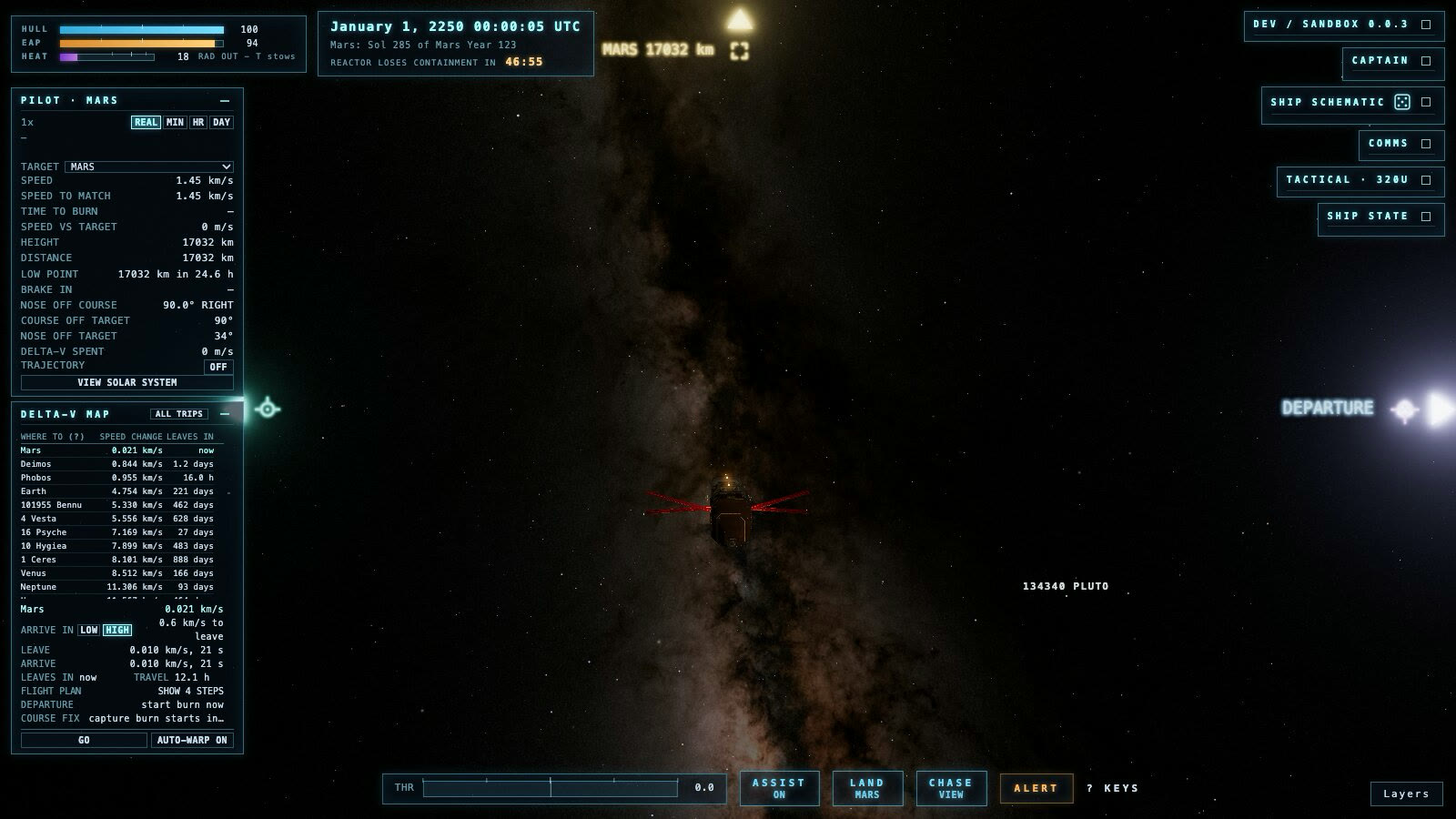
- featureLeap seconds. The sim clock renders all 27 historical leap seconds, including 2016-12-31 23:59:60Z.
- featureWeekly satellite ingest. A weekly job pulls the latest complete week of Earth-satellite orbital data, with an alarm if it ever fails.
- artColony on Jezero Delta. Landing pad, greenhouse dome and survey stakes placed across the Martian plot.
October 3
2026-10-03- featureSatellites, phase 1. A full October 3 snapshot of real satellite positions and orbits, color-coded by type.
- featureReal-Earth terrain. Mount Everest and the Alps, from orbital survey altitude down to a ground-level walkaround.
- featureTransfer windows. Autopilot offers the next, next-next and best-of-the-next-five windows for any body-to-body flight plan.
October 2
2026-10-02- featureLagrange points & barycenters. Sol-Earth, Sol-Mars, Sol-Jupiter and Earth-Luna Lagrange points, plus the Sol-Jupiter and solar-system barycenters.
- artMartian sunsets. Accurate sun scattering and atmospheric sunsets over Jezero Delta.
- fixSmall-body eclipses. Europa transits show as a dark spot on Jupiter; a Phobos transit dims Mars's sunlight by only 26–40%.
October 1
2026-10-01- featureNight-vision goggles. Exposure amplified roughly 12x for the lunar dark.
- featureShadows between bodies. Body-to-body shadow casting, checked against the real November 8, 2022 lunar eclipse.
- artIuventius Pup drive. Ignition, full burn, cutoff and cooling for the Pup's main drive.
- fixThruster ignition transient. The ignition pop on thruster start-up is smoothed out.
September 29
2026-09-29- artMars sunrise. Sunrise and atmosphere bloom at Jezero.
September 27
2026-09-27- featureexplore.4xciv.com. Pure solar-system exploration in the browser. No passphrase, no game mechanics.
September 26
2026-09-26- fixAtlas refactor. 259 merged PRs; 17,797 net lines removed from the largest file alone.
September 21
2026-09-21- featureSign in with Bike4Mind. Persistent crafting state tied to a Bike4Mind account.
September 20
2026-09-20- featureAutopilot. Real transfer windows with wait, burn and course-correction steps, from any body to any other.
- featureTerrain-aware movement. Ground movement that follows the terrain, with atmosphere that reacts to it.
September 19
2026-09-19- featureSurvey and claim. Hex-plot survey-and-claim at ground level on Jezero Delta.
September 17
2026-09-17- artLet there be light. The Sun gets real granular, flare-streaked surface detail.
- featureDelta-V Map. In-ship HUD listing travel time and speed change to every body in the system.
September 16
2026-09-16- feature21 → 37 bodies. The Jovian and Saturnian moon systems ship with real imagery.
- featureHonest gap fill. Seed-based synthetic fill where real data runs out, with a toggle to show the gap instead.
- artAsteroid belt rework. New battle-phase asteroid-belt art around Mars.
September 12
2026-09-12- featureItem catalog. 173 items across 15 categories, with crafting and colony inventory screens.
- artInventory icons. Generated icon sets for biomass, raw minerals and power equipment.
September 11
2026-09-11- featureReal gravity. All 21 bodies apply correct relative gravity; combat moves into the real system; warp up to 86,400x.
September 7
2026-09-07- featureBoots on the ground. Descents to Jezero Crater on Mars and the Apollo 15 Hadley site on the Moon.
- artJupiter and Saturn. Jupiter's cloud bands and Saturn's ring data go live; Deimos is meshed.
September 6
2026-09-06- fixTile seams. Phobos, Europa, Venus, Charon, Pluto and Ceres rebaked to remove seams.
September 5
2026-09-05- fixPhobos shape model. Phobos gets its correct shape; mouse-drag rotation direction fixed.
September 4
2026-09-04- featureQuick-select. One-click list for all 21 catalogued bodies, plus real-terrain surface descent.
September 2
2026-09-02- fixOrbit-to-surface zoom. A performance pass makes the zoom from orbit to the rocks smooth; flight HUD patched.
August 31
2026-08-31- featureColony building. Place three buildings on Jezero Delta hex plots; they persist and you can craft with them.
August 23
2026-08-23- featureBibliotheca. Raw, semantic and Ask the Magistra search over the canon.
July 21
2026-07-21- featureWhat's New panel. This feed, in-game: Artifact Viewer and ship-part updates.